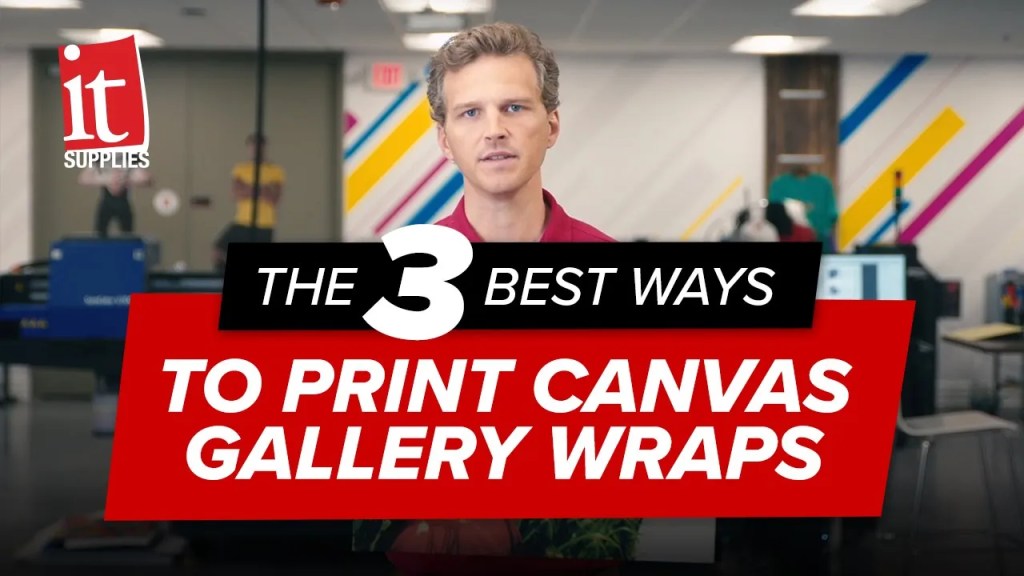
Canvas wall art continues to be one of the most popular ways that homes and businesses decorate their spaces. Canvas prints are classic and elegant, but with the right artwork they can also be contemporary and modern. Today, we’re going to look at the three most popular ways to print canvas wall art, and we’ll unpack the pros and cons to each method. At the end of this video, you will be armed with the knowledge to move forward with the right printer for your business.
So what are the strengths of using aqueous printers for canvas? For one, they offer the highest possible print quality. With ink sets of up to 12 colors, no other print technology can compete with the print quality of the best aqueous printers. Second, they offer archival ratings that are unmatched by other technologies. These ratings vary by manufacturer, but Epson’s P Series inks have lightfastness ratings up to 400 years. If you are planning to print canvas wraps for a museum, there isn’t a more archival print method. Third, they offer the most attractive entry cost. These printers typically cost between $3 and $10,000. This is the least expensive acquisition cost of the print technologies for canvas.
So what are the weaknesses of printing canvas wraps with aqueous inks? First, it has the highest running costs. Both the ink costs and the canvas material costs are the most expensive of all the canvas print technologies. So, while the initial cost of the printer is reasonable, each canvas you print will cost between $1 – $2 per square foot. Second, it is the least durable way to print a canvas wrap. Because of the nature of water-based inks, they are the most susceptible to scratching, smudging and cracking. This is especially relevant on the corners where the canvas is stretched and tugged around the gallery bars. Often aqueous printed canvases will fail in this area, and this is why many producers will use a roll on or spray laminate like Clearshield to give the canvas more scratch resistance.
The second most popular way to print a canvas gallery wrap is with a solvent printer. Solvent printers use inks that have a liquid solvent carrier. This solvent uses heat to react with the coating of the canvas and etch itself into the topcoat of the canvas. The leader in solvent art printing is Epson and their SureColor S Series line. The most popular canvas printer in the S-Series is the 9 color SureColor S80600.
So what are the strengths of using Solvent printers to print canvas gallery wraps? First, it has a running cost of less than half of aqueous canvas printing. Inks are 40-60% less expensive than aqueous printers and the range of low-cost canvases are more plentiful. Second, it provides much better scratch resistance and durability than aqueous printed canvas. This is due to the chemical reaction that bonds the solvent inks with the receptive coating on the canvas. Third, the 9-color solvent ink set in the Epson SureColor S80 provides print quality that is nearly on par with 12 color aqueous ink sets. This print quality, when paired with the productivity and reduced running costs makes a solvent printer a great choice for high production canvas operations.
What weaknesses do we see with a solvent workflow for canvas printing? First, is the solvent odor within the print room. This may not be a factor for customers running in a large warehouse setting, but for those operating the printers in or near a home or office environment this odor can be unpleasant. Second, solvent printing produces waste ink that needs to be disposed of by an authorized chemical waste disposal company. Scheduling this pickup isn’t a huge deal, but it is an extra step that isn’t needed with the other methods of canvas printing.
And this brings us to our third method of printing canvas gallery wraps, and that is using Latex or Resin based inks. This print technology uses inks that contain a resin polymer that is melted as an elastic film over the surface of the canvas. The two main players for this type of printing are HP and their vast line of Latex printers and Epson with their SureColor R5070 Resin printers.
So what are the strengths of Latex and Resin printing for canvas? First, this method provides the greatest durability and scratch resistance, even better than solvent printers. Because of the elastic film that the inks create over the surface of the canvas, the wrapped corners hold up especially well to stretching and bending. Second, using Latex or Resin print technologies eliminates the the chemical odors or byproducts found in solvent printing. Latex and Resin use water-based, no VOC carriers in their inks. This water carrier is then evaporated from the surface using heat, leaving behind the durable ink film without any chemical odor. Third, this is the best print technology for grand format canvas prints up to 126” wide. HP’s Latex 2700 and 3600 both offer 126” width print capabilities while maintaining all of the benefits of Latex canvas printing. These industrial printers not only offer the largest print capabilities, they also offer the lowest running costs of any canvas printing method.
And that brings us to the weaknesses of Latex and Resin printing. The heat that is used to evaporate the water carrier and cure the Latex/Resin ink film has some drawbacks. First, the printers require 220V power to generate the high temps used in the curing process. This can be an additional expense up front to have an electrician wire 2 220V receptacles. Second, it takes time and energy to bring these printers up to temperature so that they can begin printing and curing. This startup time is about 5 minutes, so it isn’t a huge deal if you are printing a long run of canvases, but if you are printing a canvas here and a canvas there, this would be an inconvenience. Thirdly, the Latex and Resin print technologies use the largest droplet and have the smallest color gamut. These are 6 color printers, and while they are more than capable for 90% of canvas prints, for the most discerning canvas customer there is a step down in print quality verse other print methods.
So there you have it! These are the 3 best ways to print canvas gallery wraps. They each have their strengths and weaknesses, so consider the scope of your canvas operation and what you value most about the results. If we can help you weigh your options, we’d love to spend some time listening to your specific needs and consulting with a recommendation.
Still have questions regarding Canvas Printing? Call 1-800-771-9665 and ask to talk to one of our commercial sales specialists or visit our website https://www.itsupplies.com.
IT Supplies is your single source solution for everything relating to the perfect print. We represent some of the top manufacturers in the industry. Our full lineup includes Eco Solvent, Latex, Flat Bed, and Aqueous printers by EPSON, HP, and Canon. We also carry a large selection of Dye-Sublimation and DTG Printers by both EPSON and HP. Visit us at www.itsupplies.com
 IT Supplies Blog